
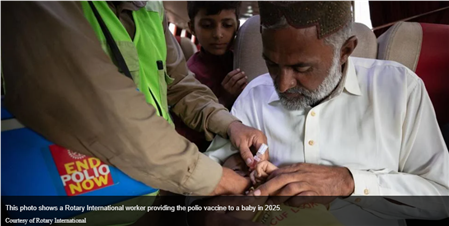
As World Polio Day approaches Saturday, Oct. 24, members of the Rotary Club of St. Joseph are highlighting the progress made through international vaccination efforts and the work that remains to eradicate the disease entirely.
Erik McGuire, a past Rotary district governor and member of the Rotary Club of St. Joseph, said the organization’s longstanding commitment has helped bring the world closer to eliminating a disease that once paralyzed hundreds of thousands of people annually.
Polio is a highly contagious viral disease that primarily affects children younger than 5. While most infected people experience no symptoms, the virus can attack the nervous system and cause permanent paralysis or death.
Before vaccines became widely available, polio was among the most feared infectious diseases in the United States. During a major outbreak in 1952, more than 21,000 cases of paralytic polio were reported nationwide.
The introduction of Jonas Salk’s polio vaccine in 1955 marked a turning point, with cases declining dramatically in the following decades.
Four decades of progress
Rotary International began its polio vaccination efforts in 1979 and established its PolioPlus program in 1985. Three years later, Rotary joined other international organizations in launching the Global Polio Eradication Initiative.

At the time, wild polio was endemic in 125 countries, with an estimated 350,000 cases occurring worldwide each year.
Since then, global polio cases have declined by more than 99%, and vaccination efforts have prevented an estimated 20 million cases of paralysis.
Rotary and its partners have helped vaccinate approximately 3 billion children worldwide, contributing more than $2.9 billion toward eradication efforts.
Although wild poliovirus has been eliminated from most of the world, transmission continues in Afghanistan and Pakistan, while outbreaks involving vaccine-derived variants can still occur in communities with low immunization coverage.
A milestone within reach
McGuire said the importance of eliminating polio extends beyond preventing the disease itself.
“We are now on the cusp of achieving something remarkable, which is the eradication of only the second disease (after smallpox) in human history,” McGuire said. “This investment in our future will pay dividends for millions worldwide, not just in decreased healthcare costs and improved life expectancy, but through the health infrastructure that now exists in nearly every corner of the world.”
Smallpox became the first human infectious disease to be eradicated worldwide when the World Health Organization formally declared it eliminated in 1980.
Rotary hopes to achieve a similar milestone with polio, although continued transmission and the threat of outbreaks mean the campaign is not yet complete.
World Polio Day serves as an annual opportunity for Rotary clubs around the world, including the Rotary Club of St. Joseph, to raise awareness and encourage continued support for eradication.
Additional information is available at www.endpolio.org.